Research
Peer-reviewed and preprint work. Unpublished systems are listed under Projects, and the full record is on Google Scholar.
-
 Listen to the Layers: Mitigating Hallucinations with Inter-Layer DisagreementKoduvayur Subbalakshmi, Sabbir Hossain Ujjal, Venkata Krishna Teja Mangichetty, Nastaran Jamalipour SoofiVenuearXiv preprintYear2026
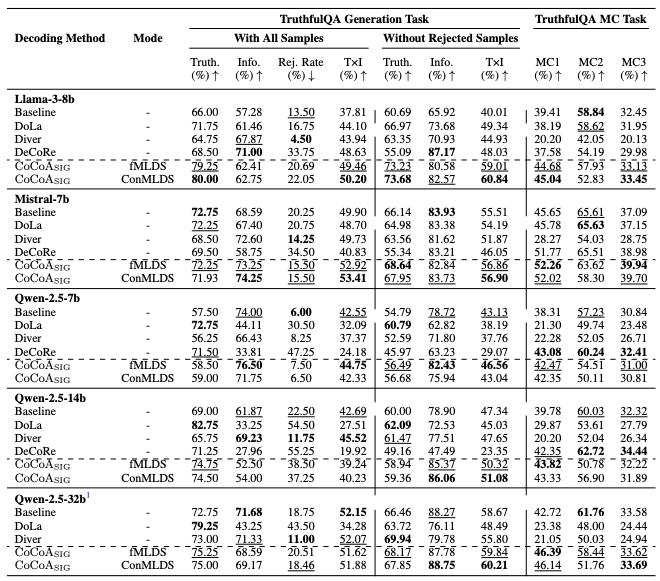
Pretrained Large Language Models (LLMs) are prone to generating fluent yet factually incorrect text-a phenomenon known as hallucinations, undermining their reliability and utility in downstream tasks. We hypothesize that a generated text span’s factuality is correlated with its representational instability across the model’s internal layers. Based on this, we propose the CoCoA (Confusion and Consistency Aware) decoder, a novel, training-free decoding algorithm that mitigates hallucinations at inference time by listening to these signals in the middle layers. We propose two metrics to quantify this instability in the middle layers and use it to penalize outputs that exhibit high internal confusion, thereby steering the model towards more internally consistent and factually grounded outputs. We further propose a self-information gated variant, CoCoA-SIG, that dynamically modulates this penalty to selectively target high-surprise, unstable generations. Extensive experiments on diverse tasks, including question-answering, summarization, mathematical reasoning and code generation, demonstrate that CoCoA significantly improves factual correctness across multiple model families (e.g., Llama-3, Qwen-2.5, Mistral). By leveraging model-intrinsic signals, CoCoA offers an effective and broadly applicable method for enhancing the trustworthiness of LLMs at inference time, without requiring any model retraining.
-
 Bridging Thought and Action: Taming Long-Horizon Instability in Open-Source LLM Agents with a MetaTool-Enhanced ROS FrameworkKazi Abrar Mahmud, Nilotpaul Kundu Dhurubo, Tamal Kirttonia, Sabbir Hossain Ujjal, Mohammad Ariful HaqueVenuearXiv preprintYear2026
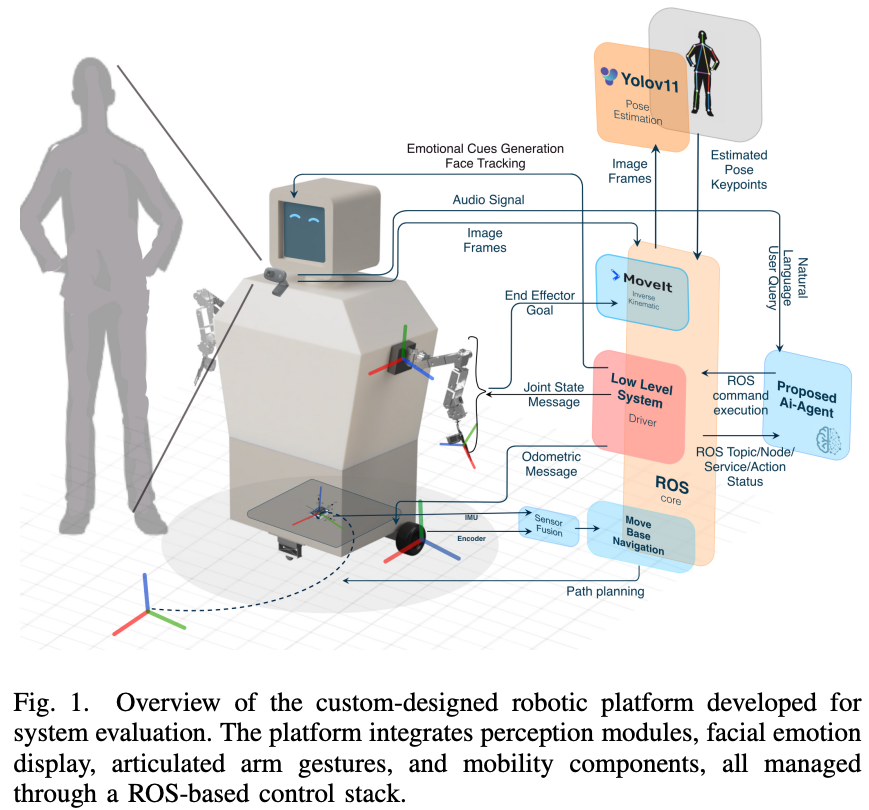
Large Language Models (LLMs) have enabled more natural human-robot interaction, but open-source models often exhibit unstable long-horizon reasoning and inefficient action execution when deployed in agentic robotic frameworks. This paper presents an enhanced ROS-Agent based architecture that improves task reliability and execution efficiency for agentic robotic systems using open-source LLMs. The proposed system introduces a novel intermediate mechanism, termed the MetaTool, which enforces structured planning prior to action execution. Given a natural-language command, the MetaTool induces the LLM to generate a pseudo-code plan of intended tool invocations, which is stored in the ROS-Agent’s scratchpad and persists throughout execution. By explicitly separating planning from execution, the proposed approach reduces execution loops and improves deterministic behavior. The architecture is validated on a custom mobile robotic platform with multimodal perception and motion control capabilities. Experimental results on real-world interactive tasks demonstrate improved task completion and contextual consistency, with up to 24% gains on complex tasks compared to the baseline framework.
-
 mTOVA: A Multilingual Task Oriented Virtual Assistant for Human Computer CommunicationSabbir Hossain Ujjal*, A F M Mahfuzul Kabir*, Mohammad Ariful Haque* Equal contributionVenue2023 IEEE International Conference on Telecommunications and Photonics (ICTP)Year2023Pages01-05DOI10.1109/ICTP60248.2023.10490454
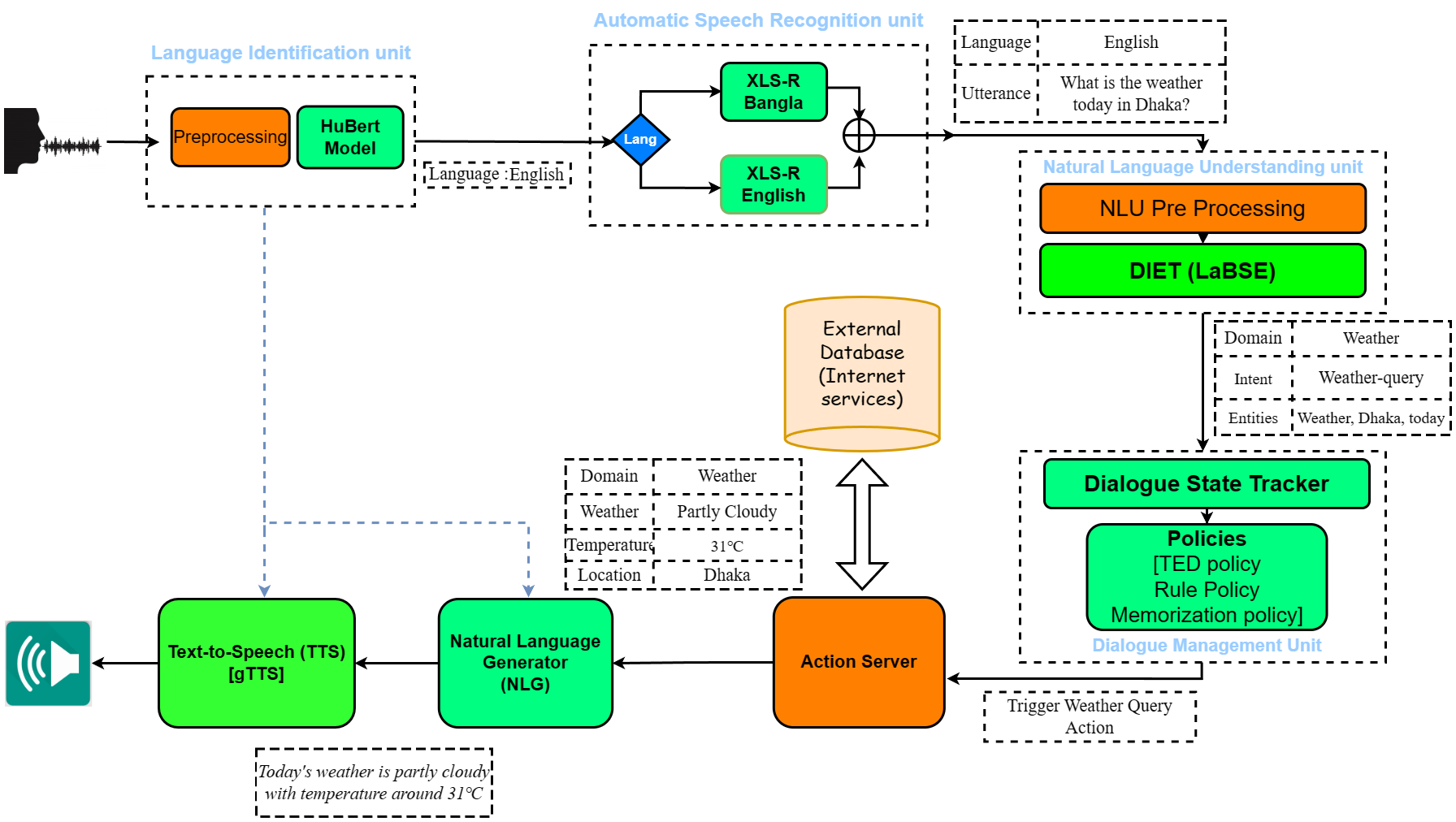
A task-oriented virtual assistant(VA) refers to an artificial intelligence driven system that can assist users to perform daily activities. The utilisation of deep learning algorithms has enabled VAs to attain noteworthy advancements in high-resource languages, such as English. However, languages with limited resources, such as Bengali, have not encountered significant advancements in this domain. In this paper, we propose a multilingual task oriented voice-to-voice conversational agent, which is capable of proficiently managing diverse tasks such as weather forecast, date & time query, hospital and blood bank search etc in both Bengali and English language. Our developed system can understand voice command using Automatic Speech Recognition (ASR) and Natural Language Understanding Unit (NLU). Then the system generates an appropriate reply by gathering information from the internet via APIs, data retrieval techniques and by employing dialogue management. Finally, Natural Language Generator (NLG) and Text to Speech (TTS) techniques are used to construct and deliver proper response. We integrated all the units using RASA framework and python script. Our developed ASR system has an average word error rate of 13% and NLU system has an intent and entity extraction accuracy of 93% and 96.2% respectively. The overall action prediction accuracy of our developed system is 99.4%.